
Honoring Black Architects in History: Pioneers Who Built a Legacy
February 18, 2025
Honoring Black Architects: Pioneers Who Built a Legacy
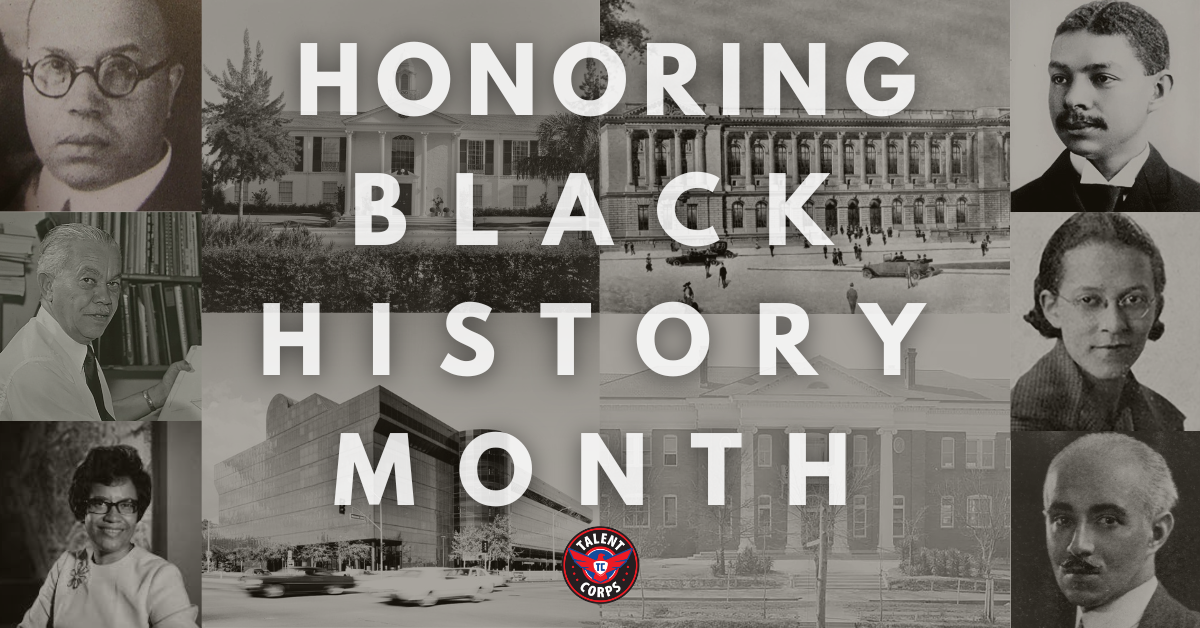
This Black History Month, Talent Corps proudly celebrates the achievements of Black architects in history. Their contributions shaped the built environment and inspired future generations. Their talent, resilience, and impact remain undeniable.
Robert Robinson Taylor: The First Accredited Black Architect
Robert Robinson Taylor made history as the first accredited Black architect in history in the U.S. He was also the first Black student at the Massachusetts Institute of Technology (MIT). At Alabama’s Tuskegee Institute, he designed around 25 buildings, including Booker T. Washington’s family home. Taylor also created three colonial-style Carnegie Libraries for Black colleges in Alabama, North Carolina, and Texas. His work set the foundation for Black educational institutions.
Norma Merrick Sklarek: Breaking Barriers for Black Women in Architecture
Norma Merrick Sklarek was the first Black female licensed architect in both New York and California. In 1959, she became the first Black woman to join the American Institute of Architects (AIA). Sklarek managed major projects like the California Mart. She also collaborated with César Pelli on the Pacific Design Center and the U.S. Embassy in Tokyo. Later, she co-founded Siegel Sklarek Diamond, the largest woman-owned architectural firm in the U.S. at the time. Her leadership and influence remain unmatched.
Paul Revere Williams: The “Hollywood Architect”
Paul Revere Williams broke racial barriers as the first Black member of the AIA in 1923. He designed homes for Hollywood’s elite, earning the nickname the “Hollywood Architect.” His commercial designs also made an impact. He created St. Jude Children’s Research Hospital, the Polo Lounge at the Beverly Hills Hotel, the Theme Building at LAX, and the MCA Building in Beverly Hills. His work remains a symbol of mid-century glamour and sophistication.
Beverly Lorraine Greene: A Visionary Cut Short
Beverly Lorraine Greene was the first African American woman to earn a Bachelor of Science in architectural engineering. She later earned a Master’s in city planning and housing from Columbia University. Greene contributed to projects like a theater at the University of Arkansas and the UNESCO United Nations Headquarters in Paris. Sadly, she passed away at 41, unable to see the completion of many of her designs. Still, her work remains influential.
Julian Abele: The Unsung Genius
Julian Abele was the first Black graduate from the University of Pennsylvania’s architecture program in 1902. Despite facing racial discrimination, he helped design major institutions. His work included Harvard’s Widener Memorial Library and the Philadelphia Museum of Art. At Duke University, he contributed to over 30 buildings, including the chapel, library, and medical school. His designs continue to inspire today’s architects.
Vertner Woodson Tandy: Architect of Harlem’s Renaissance
Vertner Woodson Tandy became the first Black registered architect in New York State. He studied at Tuskegee Institute and Cornell University. Tandy partnered with George Washington Foster, New Jersey’s first Black registered architect. Together, they shaped 20th-century Harlem. Among Tandy’s famous works is the Neo-Gothic-style Mother AME Zion Church, one of New York City’s oldest African American churches. His contributions influenced Harlem’s rich cultural and architectural history.
Building a Future Inspired by the Past
At Talent Corps, we honor these pioneers and their lasting influence. Their legacy serves as a foundation for future Black architects, engineers, and construction professionals. Black architects in history have shaped our world. This Black History Month, we celebrate their impact and reaffirm our commitment to diversity in every industry we serve.